Steam Solutions
Industrial Solutions
Rental Boiler Solutions
Steam Solutions
Industrial Solutions
Rental Boiler Solutions

When a plant is preparing for a shutdown, adding production lines or heading into its busiest season, boiler capacity quickly becomes a planning priority. Facility managers often wonder how much steam capacity a plant needs during a shutdown or expansion. The answer matters because unplanned downtime can be expensive.
Control Engineering Europe, reporting on Siemens research, notes that unplanned downtime from an idle production line at a large heavy industry plant now costs roughly $59 million a year — 1.6 times higher than it did in 2019. Understanding your true steam demand before an outage, expansion or seasonal surge helps ensure your plant’s operations remain supported and minimizes the risk of overspending on excess capacity.
One of the most common sizing mistakes is adding together the nameplate ratings of every steam-consuming asset in a facility. In reality, most systems do not operate at maximum output simultaneously.
A more accurate approach is to calculate your peak simultaneous steam load, then account for site-specific factors, such as distribution losses, future growth and operating variability. This consideration provides a practical operating buffer while avoiding significant oversizing of equipment.
The rental boiler’s required output also varies significantly based on the trigger for its deployment:
Developing proper boiler contingency planning can help you identify which required output applies to your situation. For facilities with substantial requirements, a large capacity industrial boiler rental may provide the output needed while maintaining operational flexibility.
Once steam demand has been established, the next question is which boiler design can support it. For high-capacity and high-pressure applications, a watertube boiler rental is often the better fit.
Both boiler types generate steam, but the way each is built determines how much pressure and output it can safely deliver. The comparison below breaks down where watertube and firetube designs diverge for high-capacity rental applications.
| Key Differences Between Watertube and Firetube Boilers | ||
|---|---|---|
| FACTOR | WATERTUBE BOILER | FIRETUBE BOILER |
| Pressure and capacity | Handles significantly higher pressure and output | Generally limited in high-capacity applications |
| Tube and shell design | Water circulates through smaller, externally heated tubes | Combustion gases route through tubes surrounded by water inside a larger shell |
| Practicality at scale | Remains practical as pressure and capacity requirements increase | Large pressure vessel becomes less practical at high output |
Facilities evaluating high-pressure boiler rentals should focus on watertube options when output requirements exceed the practical range of many firetube systems. You can learn more about how firetube boilers work and explore the operational differences between the two designs.
Depending on specific site conditions, boiler deployment may involve either a trailer-mounted solution or a skid-mounted configuration. If your facility is weighing capacity and pressure requirements across different configurations, you can explore boiler rental options to see how those ranges vary by unit type.
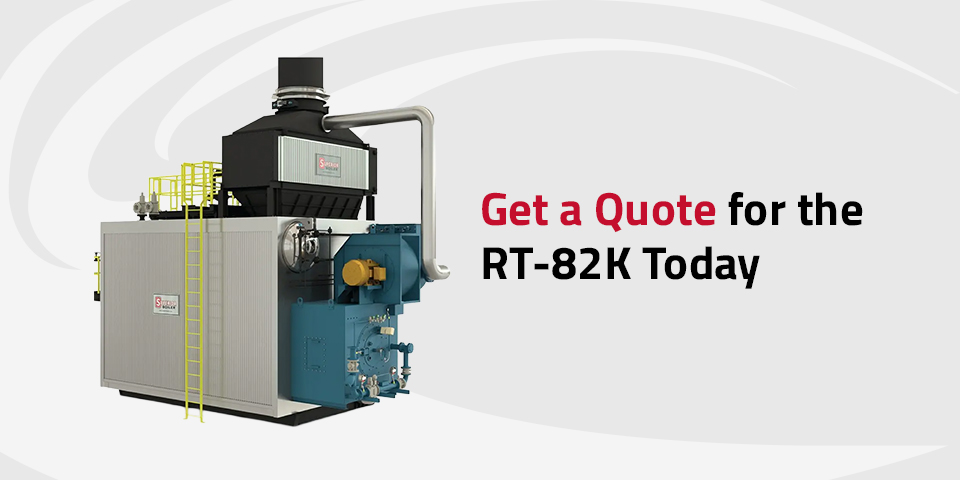
For facilities requiring substantial temporary steam output, Smith Hughes designed the RT-82K watertube rental boiler to meet demanding industrial applications. This high-capacity steam boiler rental is well-suited for facilities with significant output requirements.
The RT-82K’s key features include:
Fuel flexibility is another advantage. The RT-82K can operate on natural gas or #2 fuel oil, with propane available as an alternate fuel source. For operations seeking a multifuel or dual fuel boiler rental solution, this versatility can simplify planning during maintenance events, shutdowns and capacity expansions. This fuel advantage is also useful for seasonal surges. Breweries, for example, often see sharp production increases during peak brewing months. Understanding steam demands specific to brewery operations can help when evaluating seasonal capacity needs.
The RT-82K is also available as a trailer-mounted boiler rental, enabling rapid mobilization and installation. With its fully trailer-mounted design, facilities can often integrate the system with less site disruption than a permanent installation project.
Before startup, facility teams should verify return condensate routing, available drain points and piping conditions to reduce the potential for water hammer issues during commissioning.
Since 1946, Smith Hughes has provided boiler rentals, sales, service, repair, and turnkey installation support for facilities across the U.S. With more than 80 years of experience and a reputation built on responsive service, our company offers nationwide resources and 24/7/365 assistance from factory-trained service technicians. We are also the longest-tenured Vapor Power Boilers manufacturer representative.
If your facility needs a boiler rental for plant shutdown, facility expansion or seasonal demands, the RT-82K watertube boiler can provide the necessary output and flexibility.
Ready to discuss your steam requirements? Contact Smith Hughes today to request a quote and speak with an experienced boiler specialist.